
Mental Health Europe
There is no Health without Mental Health!
Mental health is an essential part of any citizen's health and well being. As such, it is an essential component of communities. Good mental health is a basic human right. Factors that adversely affect mental health represent a major and growing threat to economic, social and public health in the world.
Welcome to Mental Health Europe.
This site provides you with:
- Up-to-date information with key challenges in mental health.
- Information on Mental Health Europe's mission and activities.
- Access to a network of organisations concerned by the state of mental health in Europe.
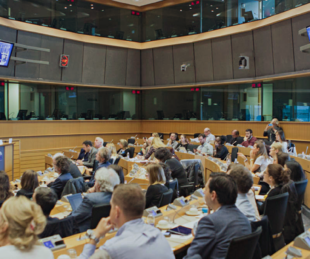
MHE organized its capacity-building seminar for MHE and ENUSP members on May 20, 2011 in Brussels. Presentations and general information, including the agenda of the seminar, are available here
NEWS! NEWS! NEWS! NEWS! NEWS!
The European Expert Group on Deinstitutionalization calls on Parliament and Council of the European Union to support community care
The European Expert Group on Transition from Institutional to Community-based Care (EEG), which Mental Health Europe is a part of, calls upon the Council of the EU and the European Parliament to uphold the ex-ante conditionalities relevant to the Structural Funds’ support of community-based alternatives to institutional care for children, persons with disabilities and mental health problems, and older persons.
The EEG – whose members are nine European non governmental organisations active in the field of social inclusion, non discrimination and fundamental rights, the European Office of the UN High Commissioner for Human Rights and UNICEF – is advocating for Structural Funds to facilitate the social inclusion of children, persons with disabilities, persons with mental health problems and older persons, and their access to quality social and health care services in the community, as an alternative to the care provided in segregating residential settings. Read the full statement here
MHE discusses mental health impact of financial crisis in Public Service Review
Mental Health Europe got featured in a two-page spread in the Public Service Review European issue, in an article highlighting why it iscrucial that mental health be puthigh on the political agenda when handling the financial crisis. MHE senior Policy Advisor Josée Van Remoortel stressed that the financial crisis threatened to reverse even the small progresses made regarding deinstitutionalisation and social inclusion. Blaming the credit crunch, governments tended to reduce the funds allocated to community-based services, leaving more and more people without support. Report sfrom the UK showed that cutting services led to some families having to send family members to residential institutions, which have long been regarded by both researchers and by disabled people themselves as inefficient, outdated, and unable to protect against human rights abuses. She also pointed ou that it is important for governments and European policy-makers to understand that the rise in mental health problems in Europe is due as muc hto the crisis as to governments’ response to it. Budget cuts, thereduction of allowances for families and disabled people, diminishing benefits and a decrease in the number of staff working in socia lservices will only worsen this already dire situation, and harm the poorest and most vulnerable members of society.
You can read the article here, or see the whole issue (MHE is featuredon page 310) here
Mental Health Europe calls on European leaders to step up the deinstitutionalization process
As we speak, 300,000 Europeans are locked up in psychiatric wards. Some literally, as the right to consent was stripped away from them due to their mental health problems, and others figuratively, as the lack of community-based services left them with no other options.
Moreover, closed psychiatric institutions have long been regarded by both researchers and by mental health service users as inefficient, outdated, and unable to adequately protect against human rights abuses and prevents from re-integration and inclusion in society. Tragedies such as that of a Czech woman killing herself after being forced into a caged bed happen all too often, and only very few of them are made public by the media.
Therefore, on the International Day for the Right to the Truth Concerning Gross Human Rights Violations and for the Dignity of Victims, Mental Health Europe is calling for European leaders to acknowledge that closed institutions cannot protect people from exploitation and abuse, to step up the deinstitutionalization process, and to offer viable alternatives for people with mental health problems to get support in the community. It is time for the inhuman, degrading, and sometimes torturous practices that are used behind closed doors in such institutions to be stopped, once and for all. Read our press release here
Mental Health Europe sends letter to the Czech Government, asking for a ban on caging
Upon hearing the disturging news of a Czech woman with mental health problems who hung herself after being placed in a caged bed, Mental Health Europe has written the Cezch Minister of Health asking for a ban on caging. Mental Health Europe is thus supporting the European Network of (Ex-)Users and Survivors of Psychiatry, who first drew attention to this horriffic abuse. Mental Health Europe has also called on the Czech Government to close down psychiatric hospitals and residential institutions, and replace them with community-based services. You can read our letter to the Czech Minister of Health here
On International Women's Day, MHE is calling for commitment, legislation and funds
Domestic violence is all too often considered a private affair, one frequently kept secret within families. However, violence against women is a crime and a severe violation of fundamental rights, and recognised as such under International human rights instruments.
Therefore, on International Women’s Day, Mental Health Europe is naming and shaming society’s often passive approach to domestic violence, hoping that battles once fought in the home will now be won in the meeting rooms of European Union (EU) institutions. The EU needs to commit to further allocating funds for projects on domestic violence, to finally shed light on this shameful practice and help the millions of women victims and survivors. Furthermore, Mental Health Europe reiterates its call for an EU strategy on violence against women and supports the demand by numerous organisations for a European Year to end violence against women in the near future. Read our press release here
EU must urgently respond to soaring poverty rates across Member States - MHE press release on the occasion of the World Day of Social Justice
The strength of a democracy can be judged by how much weight is placed on equality, solidarity and human rights in the policy process. Still, if we were to judge European Union (EU) Member States based on how the poorest and most vulnerable people are faring, especially during the financial crisis, the results would be disappointing at best. Therefore, on the World Day of Social Justice, Mental Health Europe (MHE) is calling on the EU Institutions and national governments to seriously engage with the European Platform Against Poverty (EPAP) – a flagship of the EUROPE 2020 strategy. Read our press release here
MHE welcomes the European Year for Active Ageing and Intergenerational Solidarity
Mental Health Europe welcomed the official launch of the European Year 2012 by underlining the strong connection between employment and mental health in older people. For older people, staying in employment contributes not only to an increased level of financial security, but also to a more fulfilling social life and a stronger sense of belonging to community. At the same time, employers can greatly benefit from hiring older workers, who may have a more holistic approach due to the knowledge and expertise accumulated during their working life. Read our press release here
MHE gets featured on EU Observer
Watch MHE Human Rights Officer Gabor Petri talk about how people with mental health problems are perceived in society, and about the transition from institutional to community services here.
MHE to organize lunch debate at European Parliament
Mental Health Europe decided to choose active ageing as the topic for its 2011 Awareness-raising event at the European Parliament. Together with MEP Frieda Brepoels, MHE is organizing a lunch debate where mental health professionals and government officials will have the opportunity to discuss the value older people bring to the workplace, and the innovative new mechanisms needed for older people to continue contributing to society in a meaningful and constructive manner.
Staying active – The impact of (un)employment on the mental health of an ageing Europe will take place on Wednesday, December 7, at the European Parliament in Brussels. Speakers will include Richard Wynne, Director of Work Research Centre in Ireland, Bart Julliams, Adviser for Employment in the Cabinet of Philippe Muyters, Flemish Minister of Finance, Budget, Employment, Planning and Sport, Jacques van der Vliet from the Standing Committee of European Doctors and Brian Howard, CEO of Mental Health Ireland.
Call for contributions for MHE's 2012 Conference is now open
Mental Health Europe is announcing a call for contributions for its 2012 Conference. We welcome abstract submissions for the following parallel sessions:
- Meeting the basic needs of children and youth as an investment in the future
- Changing the attitude of employers towards people with mental health problems
- A framework for the establishment of strong and supportive networks
- The role of volunteering in establishing networks in rural and remote areas
- The human rights aspect of the access to quality community-based services
- Deinstitutionalisation and the UNConvention on the Rights of Persons with Disabilities
- The role of the media in changing people’s attitudes towards mental health issues
- Solidarity between generations in themental health field – Round Table debate
To submit an abstract, of 400 words at most, please complete this form (here in PDF) and send it to Yves Brand at yves.brand@mhe-sme.org and Maja Soco atmaja.soco@stokoluri.org by March 15, 2012
MHE 2012 Conference to engage social determinants of mental health
Mental Health Europe (MHE) has decided to dedicate its 2012 Conference to engaging with the social determinants of mental health, in a bid to emphasize the role society plays in both reinforcing and addressing inequalities. The MHE conference, “From individual to collective responsibility – The social determinants of mental health,” organized in Split, Croatia between June 14-16, 2012, will bring together experts from the European Commission, the WHO and the United Nations to present different methods for improving the social environment in schools and workplaces, encouraging inclusion within the community, and developing strong and supportive networks which can have a positive impact on mental health. Grass roots experts will also contribute with examples of good practices found throughout Europe. For more information, please contact MHE at info@mhe-sme.org
Lack of employment damages youth mental health
Amid the violent riots in the United Kingdom (UK), International Youth Day bears less of a celebratory feeling. Instead, it is a painful reminder that society has been failing its youth, especially regarding education and employment. And sadly, when the mainstream society suffers, the effect on the most vulnerable people is felt tenfold. Young people with mental health problems often leave school early due to widespread prejudice, while the lack of qualifications means they will likely remain unemployed for long periods of time. Read our press release here
UN sheds light on forgotten Europeans
In an attempt to stimulate discussion on the need for governments to develop community based alternatives to institutional care, the United Nations (UN) Office of the High Commissioner of Human Rights issued an important account of the human rights standards relevant to people with disabilities. Mental Health Europe (MHE) thoroughly welcomes the “Forgotten Europeans, Forgotten Rights” report, which is undoubtedly a useful tool for both lobbyists and policy-makers. Read our press release here
Equating mental health problems with violence - Prejudices resurface in corevage of Norway killings
The killings in Norway have left 77 people dead and a whole world mourning. In a shocking attack on humanity and the values Europeans hold dearly, Anders Behring Breivik has demonstrated the dangers of extremism, be it religious or political. Breivik can be called many things - a murderer, assailant or plotter – but Mental Health Europe believes it is unfair and irresponsible to call him a madman, at least until any mental health problem he might suffer from is duly proven in court. Read our press release here
The reports and presentations from our National Focal Point training sessions in 2011 are available here
Mental Health Europe priorities for the Polish Presidency
The Polish Presidency will start its mandate on July 1, 2011, in the midst of political turmoil fuelled by economic uncertainty. But it is in times of trouble that real leadership is demonstrated, thus Mental Health Europe urges the coming Presidency to remember EU’s most vulnerable citizens and to take charge in further shaping social policy. Read our press release here
National Reform Programmes fare poorly in social inclusion objective
On June 24, the EU Heads of States and Governments will get together to adopt country-specific recommendations for the member states’ National Reform Programme 2011. Mental Health Europe (MHE) and its National Focal Points, have conducted an analysis of the National Reform Programmes, focusing on whether they met social inclusion requirements. The results were overwhelmingly disappointing. Read our press release here and our analysis here.
Mental health problems trigger strongest prejudice, WHO report finds Although one in four people will experience some sort of mental health problems during the course of their lives, users or ex-users of mental health services were found to be the most discriminated and stigmatized of all disabled people, often with deadly consequences. Read our press release here
MHE welcomes set up of Joint Action on Mental Health and Well-being
Mental Health Europe (MHE) is pleased to see the Council of the European Union taking an active step in mainstreaming mental health by inviting the European Commission and European Union (EU) Member States to develop a Joint Action on Mental Health and Well-being under the EU Public Health Programme 2008-2013. MHE thoroughly welcomes this initiative, and encourages the Commission and EU Member states to promptly get involved, keeping mental health and well-being high on both the EU and on national political agendas. Read our press release here
Rights of people with mental health problems must not be restricted. Joint MHE-ENUSP Statement
The Hungarian Parliament recently approved the country’s new Constitution, which should enter into force on January 1, 2012. This document should reinforce the inalienable human rights of all Hungarians as set out in international law. However, Mental Health Europe (MHE) and the European Network of (ex-)Users and Survivors of Psychiatry (ENUSP) are shocked that the new Hungarian Constitution not only fails to do so, but actively strips away the voting rights of people with mental health problems. Read our statement here
The Mental Health Europe Annual Report 2010 is available here

.jpg)
.jpg)